Example: Circuit reduction

Left
- Which devices are in series? (ℰ and R1)
- ↑ single wire (on left) connects the two
- Which devices are in parallel? (R2 and R3)
- ↑ branched wire connects left, and a second branched wire connects right
- Which devices are in series? NONE
- Which devices are in parallel? (R1 ∥ R2, R3 ∥ R4)
- Note: R1 is not parallel to R3 or R4
Problem: bulb brightness
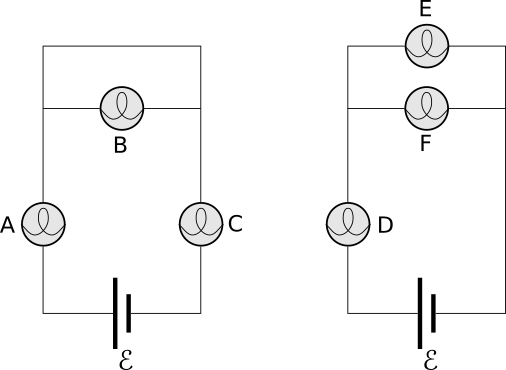
Question
- 6 identical light bulbs (resistance R), connected into circuits with two identical batteries.
- Rank bulbs by brightness (least to greatest)
- Which circuit consumes more power?
- Currents: B = 0, E = F = ℰ / (3R), A = C = ℰ / (2R), D = ℰ / (1.5R)
- Remember, power consumed = power supplied by the battery = ℰ × (current through battery)
- Left power = ℰ2 / (2R)
- Right power = ℰ2 / (1.5R)
- Let ℰ = 2.0V, R = 1.0Ω
- IL = 1.0A, Pbatt = 2W, PA = PB = 1W
- IR = 1.3A, Pbatt = 2.7W, PD = 1.8W, PE = PF = 0.44W