Problem: Point Charge Forces
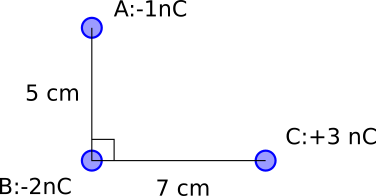
- Show the directions of the two forces on charge A
- Compute the magnitudes of the two forces
- Compute the compute the components of the two forces
- Compute the components of the total force on A
- Compute the magnitude of the total.
- Compute the direction of the total.
Directions
- FBA is a push , so direction = up (θ = 90°)
- FCA is a pull, so it has the same direction as the line from A to C (down and right).
- Line direction (x-component = +7 cm, y-component = -5 cm, θ = atan(-5/7) = 325°)
- FBA: q1 = -1 nC, qs = -2 nC, r = 5 cm
- FBA = 7.2×10⁻⁶ N
- FCA: q1 = -1 nC, q2 = +3 nC, r = sqrt(52 + 72)cm = 8.6 cm
- FCA = 3.65×10⁻⁶ N
- FBAx = 0, FBAy = +7.2×10⁻⁶ N
- FCAx = +3.0×10⁻⁶ N, FCAy = -2.1×10⁻⁶ N
- Sum Fx = +3.0×10⁻⁶ N, Fy = +5.1×10⁻⁶ N
- F = +5.9×10⁻⁶N
- θ = -60°
- FAB is a push , so direction = down (θ = 270°)
- FCB is a pull, so direction = right (θ = 0°)
- FAB: q1 = -1 nC, qs = -2 nC, r = 5 cm
- FBA = 7.2×10⁻⁶ N - NOTE this is the same as FAB above. Coulomb's law obeys Newton's 3rd law.
- FCB: q1 = -2 nC, q2 = +3 nC, r = 7 cm
- FCA = 1.1×10⁻⁵ N
- FABx = 0, FABy = -7.2×10⁻⁶ N
- FCBx = +1.1×10⁻⁵ N, FCAy = 0
- Sum Fx = +1.1×10⁻⁵ N, Fy = -7.2×10⁻⁶ N
- F = +1.3×10⁻⁵N
- θ = -33°